
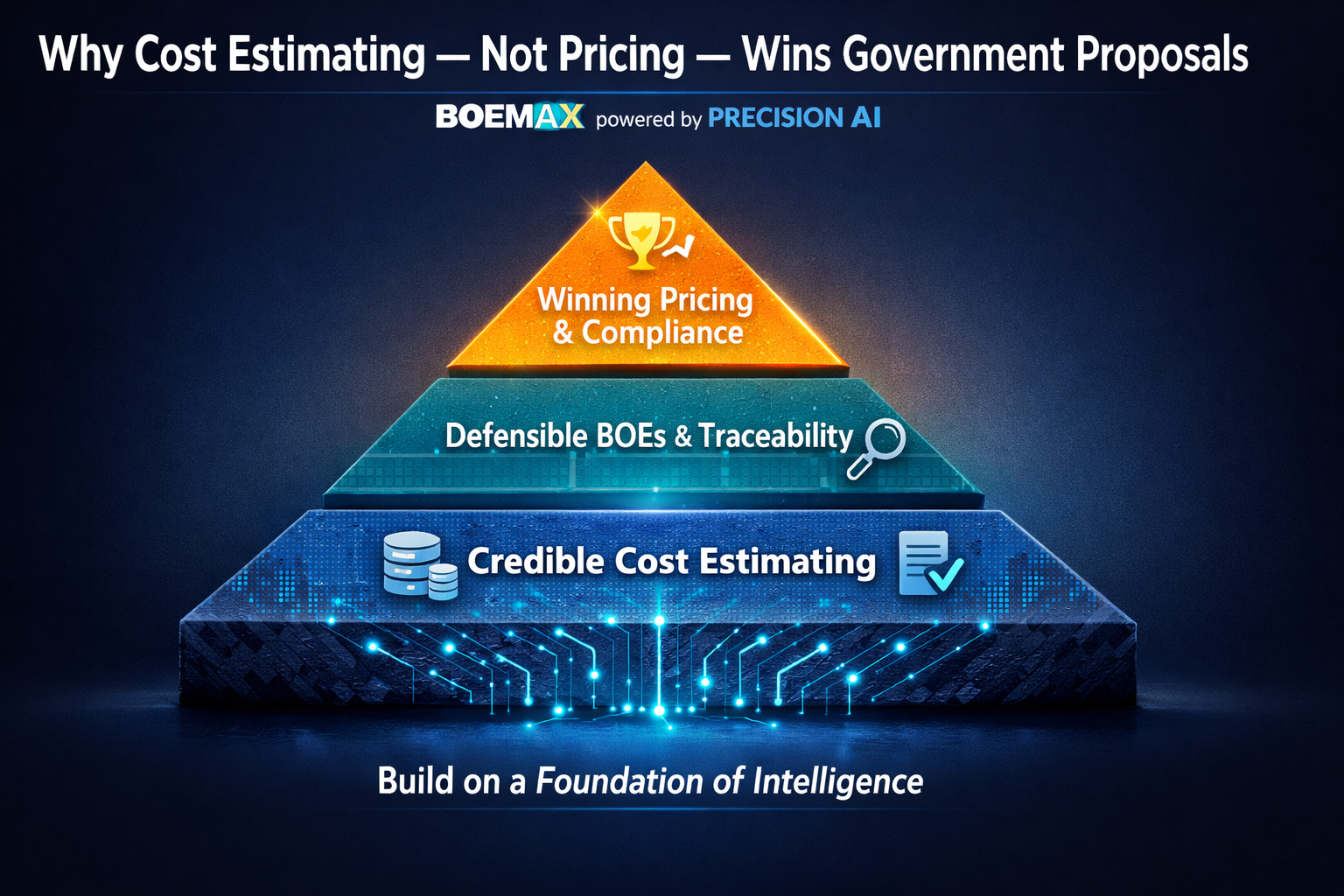
In government contracting, pricing compliance has long been treated as the finish line. If the proposal is compliant, auditable, and mathematically sound, the assumption is that the job is done.
But experienced cost estimators and proposal teams know better.
Winning proposals aren’t built on compliance alone. They’re built on credible, data-driven cost estimates that tell a clear story—one that evaluators can trust and internal reviewers can defend. Pricing is simply the output of that process, not the process itself.
That distinction is exactly why BOEMAX powered by Precision AI exists.
BOEMAX is not just another pricing tool that happens to support cost estimating. It is a true cost estimating and analysis platform, purpose-built for government contract proposals, with pricing capability as a downstream outcome—not the core identity.
Cost Estimating Is the Foundation of Every Defensible Proposal
At the heart of every strong proposal is a well-constructed Basis of Estimate (BOE). That BOE answers questions long before numbers ever reach a pricing volume:
Where did these costs come from?
What data supports them?
How do they relate to past performance?
Why should the government believe them?
Traditional pricing-centric tools tend to emphasize structure, formats, and compliance artifacts. They excel at generating rate tables and rollups, but they often leave the hardest part—cost reasoning and justification—to spreadsheets, narratives written after the fact, and institutional memory.
BOEMAX flips that model.
Cost estimating comes first. Analysis comes first. Traceability comes first. Pricing follows naturally from a well-supported estimate.
That is why BOEMAX is fundamentally different.
Built Specifically for Government Proposal Cost Estimating
BOEMAX was designed with the realities of government proposals in mind. It understands that estimators are juggling historical data, labor mappings, indirect structures, escalation, assumptions, and constant iteration—all under intense schedule pressure.
Instead of forcing users to contort their estimating process to fit a pricing engine, BOEMAX supports how estimators actually work:
- Estimates are grounded in historical and internal data
- Assumptions are explicit, captured, and reusable
- Cost elements remain traceable from source data through proposal submission
- BOEs are living artifacts, not last-minute narratives
This is where Precision AI becomes a force multiplier.
Precision AI: Turning Your Data into Estimating Intelligence
Precision AI is not about replacing estimators or automating judgment. It is about unlocking the value of your own data.
Most organizations already have years of historical proposal, contract, and cost data. The problem is that data is scattered, underutilized, and difficult to apply consistently across new efforts.
Precision AI helps bridge that gap by:
- Learning from your historical estimates and outcomes
- Surfacing relevant data patterns during estimating
- Assisting with BOE justifications grounded in actual evidence
- Reducing repetitive manual analysis while preserving estimator control
The result is not “AI-generated estimates,” but AI-enabled estimators—professionals who can move faster, justify more clearly, and make better-informed decisions without sacrificing rigor.
From One-Off Estimates to Closed-Loop Learning
One of the most overlooked challenges in cost estimating is that most tools treat every proposal as a standalone event. Once a proposal is submitted, the learning largely stops.
BOEMAX changes that.
Every estimate becomes an input to future estimates. Every proposal strengthens the underlying data foundation. Over time, organizations develop:
- Greater estimating consistency
- Improved cost realism
- Faster proposal turnaround
- Stronger institutional knowledge that survives staff turnover
This closed-loop learning model is where BOEMAX moves from being a tool to becoming a strategic capability.
A Quiet Comparison: Estimating-First vs. Pricing-First Tools
Without naming names, it’s worth acknowledging a common distinction in the market.
Many legacy tools are fundamentally pricing-first. Their primary strength lies in generating compliant pricing outputs. Cost estimating, while supported, often becomes a secondary activity layered on top of pricing structures.
BOEMAX takes the opposite approach.
It is estimating-first:
- Designed around BOEs, assumptions, and analysis
- Focused on data traceability rather than just compliance artifacts
- Optimized for learning from historical data, not just reusing templates
- Built to support how estimators think, not just how prices are formatted
For organizations that view pricing compliance as the goal, pricing-first tools may be sufficient. For organizations that view cost credibility and competitiveness as the differentiator, BOEMAX offers a fundamentally different value proposition.
A Competitive Advantage Hiding in Plain Sight
When estimators are empowered with better data, better tools, and better insight, the benefits compound quickly. Estimates become faster to build, easier to justify, and more defensible under scrutiny. Reviews improve. Risk decreases. Confidence increases.
Most importantly, proposal teams stop reacting and start learning.
BOEMAX powered by Precision AI doesn’t just help teams submit compliant proposals. It helps them build better estimates, stronger BOEs, and more competitive offers—again and again.
And in a market where margins are tight and differentiation is hard to find, that raises an obvious question:
Why wouldn’t you want cost estimating itself to be your advantage?
Cost Estimating Beyond Compliance: A Four-Part Series
In government contracting, pricing compliance is often treated as the goal. But experienced proposal professionals know compliance alone doesn’t win contracts—credibility does.
This four-part series explores why cost estimating, not pricing mechanics, is the true driver of competitive proposals. From the limitations of compliance-first thinking to the role of BOEs in shaping win themes and evaluator trust, these articles examine how mature cost estimating practices reduce risk, improve clarity, and strengthen proposal outcomes.
Together, they challenge conventional assumptions about pricing tools and offer a more strategic perspective on how cost estimates influence not just numbers—but confidence, consistency, and wins.
Series Overview:
- Pricing Compliance Is Not a Strategy
- Cost Estimating Is the Strategy
- From BOE to Win Theme: Connecting Cost and Story
- Why Evaluators Trust Some Cost Volumes More Than Others

