
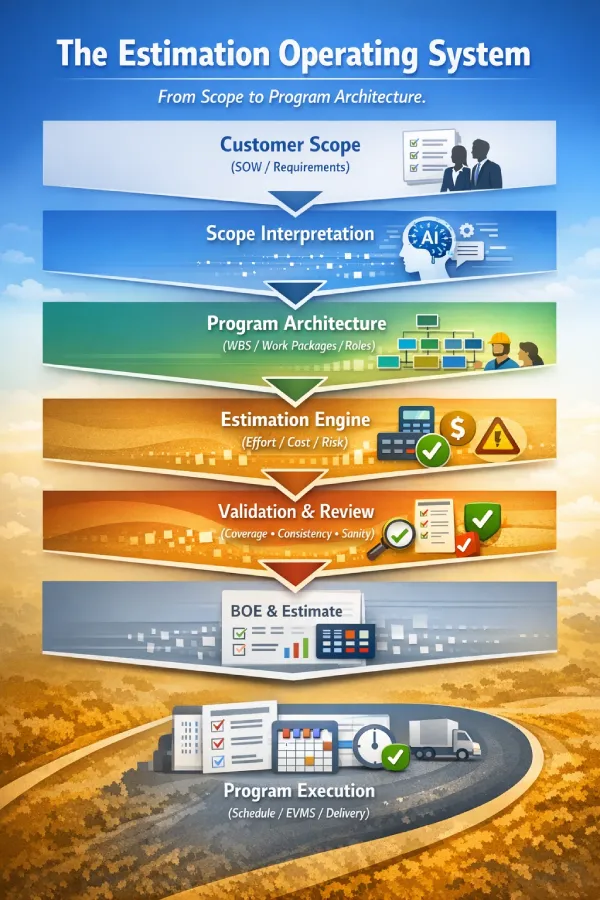
At a high level, the Estimation Operating System functions as an orchestration layer connecting scope, program structure, cost estimation, and execution planning.
This architecture allows the estimation process to behave like a living system rather than a static document.
As scope evolves, structure evolves.
As tasks change, validation checks run automatically.
As the estimate changes, the narrative remains synchronized.
The result is not automation for its own sake.
The result is orchestration.
The End of “Starting From Scratch”
Ask any estimating team what slows them down most and you will hear the same phrase:
“We’re starting from scratch.”
In reality, most organizations possess enormous estimating knowledge already:
• historical estimates
• previous work package structures
• prior program narratives
• lessons learned from execution
The problem is that this knowledge exists as disconnected artifacts.
Spreadsheets. PDFs. File folders. Tribal memory.
An estimation operating system allows organizations to treat that knowledge as institutional intelligence rather than archived paperwork.
Instead of rebuilding estimates manually, teams can start from structured foundations and refine from there.
That shift dramatically increases proposal velocity.
The Defensible 70% Estimate
One practical outcome of this shift is the concept of the defensible 70% estimate.
This is not a rough guess.
It is not a final estimate either.
It is the point where:
• scope has been decomposed into credible work packages
• roles align logically to tasks
• effort levels are plausible
• narrative justification remains consistent with the numbers
At this stage, leadership can review the estimate with confidence.
Human expertise still refines the estimate, but the structure already exists.
This allows organizations to move from blank-page estimation to structured iteration.
Trillions of Dollars, Decades-Old Workflows
Trillions in Engineering Programs
Program estimation sits at the center of trillions of dollars of global engineering work across aerospace, defense, infrastructure, energy, and advanced manufacturing.
Yet the core workflow used to produce estimates has barely changed in decades.
Most programs still begin with:
interpret scope → build WBS → assign roles → estimate effort → reconcile narrative.
The tools may look modern.
But the underlying workflow is largely unchanged.
That gap between program scale and workflow evolution is why estimation is emerging as one of the most important operational frontiers in engineering organizations.
From Proposal Artifact to Program Architecture
The most strategic implication of an estimation operating system is what happens next.
When scope is decomposed into structured work packages with traceability, the estimate becomes more than a proposal deliverable.
It becomes the first structured model of the program itself.
From that structure, organizations can begin connecting estimation directly to execution:
• schedule development
• backlog planning
• requirements traceability
• EVMS structures
• delivery planning
Estimating becomes the bridge between customer scope and program execution.
The Next Era of Estimating
For decades, estimating has been treated as a necessary step in the proposal process.
But the emergence of AI-enabled orchestration systems is transforming estimation into something much larger.
Not a document.
Not a spreadsheet.
But a system that continuously converts scope into structured program architecture.
The companies that recognize this shift early will gain a powerful advantage.
They will bid faster.
They will learn faster.
And over time, their estimating systems will accumulate institutional intelligence that compounds into strategic capability.
In other words, they will not just build better estimates.
They will build the operating system for program estimation.

